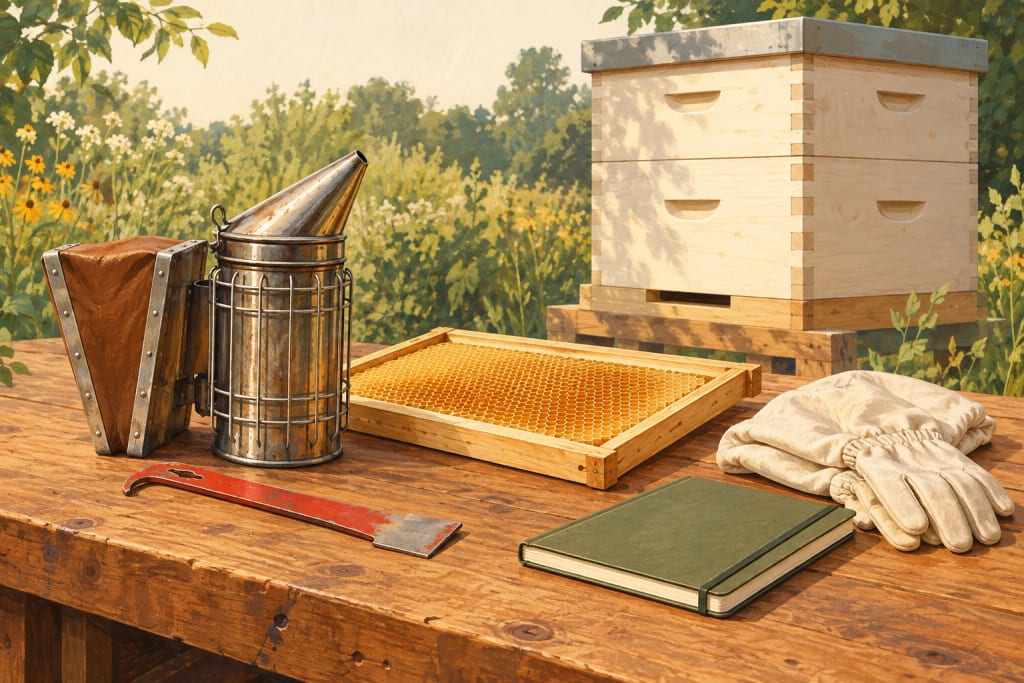
A single Langstroth hive setup costs $350–600 in the US for your first year — hive kit, bees, protective gear, tools, and your first varroa treatment included. Year two drops to $80–150 per hive. The equipment is a one-time investment; the bees are the ongoing variable.
Affiliate links — we earn a small commission at no extra cost to you. Full disclosure →
Every spring, the same question lands in beekeeping forums with the same anxious energy: “I want to start — but how much is this actually going to cost me?”
The answers are usually too vague (“it depends!”), too optimistic (“I started for $200!”), or buried in five years of inflation. This article is the honest version. We will walk through every item — what it costs in the US, UK, and Europe in 2026 — and explain why each expense exists, not just what the price tag says.
The Short Version: First-Year Cost Breakdown
Before we go line by line, here is the complete picture.
| Item | Low estimate | High estimate |
|---|---|---|
| Hive kit (Langstroth 10-frame) | $150 | $220 |
| Nucleus colony (5-frame nuc) | $175 | $250 |
| Full protective suit | $65 | $130 |
| Leather gloves | $25 | $45 |
| Smoker | $30 | $55 |
| Hive tool | $8 | $18 |
| Varroa treatment (Apivar) | $20 | $35 |
| Feeder + first bag of sugar | $18 | $30 |
| A good beginner’s book | $18 | $30 |
| Total | ~$510 | ~$813 |
The middle of that range — around $600–650 — is where most beginners actually land. The gap between low and high comes down almost entirely to whether you buy entry-level or mid-grade gear, and whether your bees cost $175 or $250 depending on your region and supplier.
Now let us look at each category honestly.
The Hive
Before buying equipment, use the beekeeping starter kit comparison and checklist to distinguish a hive-only package from a kit with tools. It helps you identify missing items and avoid budgeting twice for equipment already included.
Why Langstroth is the right starting point
There are three main hive designs a beginner will encounter: the Langstroth (the standard rectangular box), the Flow Hive (plastic frames with a honey-on-tap mechanism), and the Top Bar (a horizontal log-shaped alternative). We cover all three in depth in our Langstroth vs Flow Hive vs Top Bar comparison, but for cost purposes, the decision is straightforward.
Langstroth equipment is the most widely available, the cheapest to replace, and the format your local beekeeping club will know how to help you with. If a frame breaks, you buy another for $3. If you need a mentor to walk through your hive, the Langstroth is what they will have in their garden.
What a hive kit actually includes
A standard 10-frame Langstroth starter kit typically contains:
- One deep brood box (where the colony lives and raises young bees)
- One medium super (where they store honey for your harvest)
- Ten deep frames with wax foundation
- Ten medium frames with wax foundation
- Inner cover
- Telescoping outer cover
- Bottom board with entrance reducer
Some kits include a queen excluder — a metal mesh that keeps the queen out of your honey super — and some do not. Worth confirming before you buy.
What a hive kit does not include: the bees. This is the most common point of confusion for new beekeepers. The box is sold separately from the colony.
Price range (US, 2026)
A solid, unassembled 10-frame kit from a reputable supplier — Mann Lake, Dadant, Brushy Mountain — runs $150–220. Assembled kits cost $20–40 more and are worth it if woodworking is not your thing; gaps and warped joints invite pests and weather damage.
One of the most widely used entry-level Langstroth kits in the US. Includes brood box, super, frames with wax foundation, covers, and bottom board. Unassembled — plan for 2–3 hours with wood glue and a hammer.
Affiliate link — we earn a small commission at no extra cost to you. Full disclosure →
UK: £120–180. Europe: €140–200. Local suppliers often have slight advantages here over shipping from US distributors.
The Bees
This is where first-year costs are most variable — and most misunderstood.
Nucleus colony vs. package bees
You have two main options for acquiring your first colony:
A nucleus colony (“nuc”) is a small, already-established colony on 5 frames: brood in various stages of development, food stores, worker bees, and — critically — a mated, laying queen. You slide these 5 frames into your new hive box, add empty frames to fill it out, and the colony begins expanding immediately. The queen is proven. The workers are already in a rhythm. This is the gentler start.
A package of bees is roughly 3 pounds of bees (around 10,000 workers) and an unmated or newly-mated queen shipped in a screened wooden box. The queen is in a small cage suspended inside; the workers must eat through a candy plug to release her over 3–5 days. You install them into your empty hive and wait. It works, but it requires a queenless period and a longer establishment time before the colony begins growing in earnest.
For most beginners, a nucleus colony is worth the extra $25–50. The colony is more resilient out of the gate, and you can inspect actual brood patterns — a critical skill — from your very first visit.
What bees cost in 2026
Nucleus colony (5-frame): $175–250 in the US, depending on your region and supplier. The Northeast and Pacific Northwest tend to be on the higher end; the South and Midwest slightly lower. Local club members often sell nucs in April and May — this is almost always the best deal and the best quality.
Package bees: $135–185 for a 3-lb package. Less expensive upfront, but factor in the higher establishment risk.
UK: A nucleus colony runs £200–280. Local associations and the British Beekeepers Association (BBKA) often help connect buyers with sellers.
Europe: €200–300 depending on country and bee race (Carniolan, Buckfast, and Italian lines are common).
One honest note: buy locally whenever possible. Bees shipped long distances are stressed. Local bees are adapted to your climate. Local suppliers stake their reputation on every nuc they sell.
Protective Gear
The full suit
Beekeeping without adequate protection is a decision you will revisit after your first aggressive inspection. A full suit — hood, veil, jacket, and legs all in one — is the right call for a beginner. You will move more confidently, which means calmer bees, which means fewer stings.
A decent entry-level full suit costs $65–100. Mid-grade cotton-poly blends with fencing-style veils (the rounded veil that stands away from your face) run $100–130 and are noticeably more comfortable for summer work.
Avoid the cheapest suits (under $50) — the zippers fail, the veil mesh tears, and the material breathes like a garbage bag. Avoid the most expensive suits ($250+) until you know this is a long-term commitment.
A well-regarded full suit that holds up to regular use. Fencing veil keeps fabric away from your face; multiple zippered pockets; elastic cuffs at wrist and ankle. Available in sizes S–3XL.
Affiliate link — we earn a small commission at no extra cost to you. Full disclosure →
UK/Europe pricing: A comparable suit runs £60–100 / €70–110.
Gloves
Leather beekeeping gloves are the standard — they protect against stings while allowing enough dexterity to handle frames. Expect to pay $25–45 for a decent pair with canvas gauntlet cuffs that extend up the forearm.
Some experienced beekeepers eventually switch to nitrile surgical gloves (or no gloves at all) for better feel. As a beginner, use the leather gloves. Stings to the hand, particularly near knuckles, are disproportionately uncomfortable.
Genuine cowhide leather with long canvas ventilated gauntlets. One of the more durable options at this price point — the stitching holds. Available in S, M, L, XL.
Affiliate link — we earn a small commission at no extra cost to you. Full disclosure →
Tools
The smoker
A smoker does two things: it masks the alarm pheromone bees release when disturbed, and it triggers a feeding response that makes bees less defensive. An 11-inch steel smoker with bellows and heat shield costs $30–55.
Do not buy the $12 smokers. The chambers are too small to hold a sustained burn, the bellows crack within a season, and you will be relighting it mid-inspection — which is exactly when you do not want to stop what you are doing.
Steel construction with heat shield and leather-wrapped bellows. Holds a good burn for a full hive inspection. A reliable workhorse at a fair price.
Affiliate link — we earn a small commission at no extra cost to you. Full disclosure →
What to burn: burlap, dried pine needles, wood pellets, or commercial smoker fuel. Most beekeepers spend $10–20 a year on fuel.
The hive tool
This flat pry-bar — usually J-shaped at one end — is how you separate frames that bees have sealed together with propolis. Cost: $8–18. Buy two; you will lose one in the grass during your first inspection.
Optional tools beginners often buy too soon
- Bee brush: $8 — useful but not essential
- Frame grip: $12 — makes pulling frames easier; nice to have, not required
- Queen catcher: $5 — only relevant if you start making splits
Skip these until you have a full season under your belt. The beginner’s temptation is to equip for every scenario. The reality is that you will be fully occupied just learning to read a frame.
Varroa Treatment — The Non-Negotiable
Here is the part of beekeeping costs that nobody talks about enough, and that causes more first-year hive losses than anything else.
Varroa destructor is a parasitic mite that feeds on developing bees and transmits a suite of debilitating viruses. It arrived in North America in the late 1980s and has since become the single greatest threat to managed honeybee colonies worldwide. Untreated colonies typically collapse within 2–3 years, and increasingly, within a single season in high-mite-pressure areas.
Treatment is not optional. It is as fundamental as the hive itself.
Apivar strips
Apivar (amitraz-impregnated plastic strips) is the most reliable, beginner-friendly varroa treatment. You hang two strips in the brood chamber for 42–56 days; the bees walk across them and distribute the active ingredient throughout the colony. No timing windows, no temperature restrictions.
A pack of 10 strips — enough to treat 5 hives — costs $20–35. Most beginners use 2 strips per hive, once in late summer and once in autumn, costing roughly $8–14 per hive per treatment round.
The standard amitraz treatment, now bundled with the Varroa Easy Check alcohol wash kit for monitoring mite loads before and after treatment. If you only buy one varroa-related product your first year, make it this.
Affiliate link — we earn a small commission at no extra cost to you. Full disclosure →
You will also want to monitor mite levels — both before treating (to confirm you need it) and after (to confirm the treatment worked). An alcohol wash or sugar roll with a Varroa Easy Check cup is the gold standard. Cost: included in the bundle above, or $12 on its own.
Feeding
A new colony installed in spring needs supplemental feeding to help it establish before the nectar flow begins — or if you install late and the flow has already peaked. Standard practice is a 2:1 sugar syrup (by weight: 2 parts sugar to 1 part water) fed in a hive-top feeder or entrance feeder.
Entrance feeder: $8–12. Simple, effective, but requires more frequent refilling. Hive-top feeder: $18–28. Holds more syrup, less disturbance to the colony, generally preferred.
A 25-lb bag of white granulated sugar costs $15–20 and will feed a new colony through its first establishment period. Total feeding budget for year one: $18–35.
Education
A book you will actually read
The best $18–30 you will spend is on a reference book. Not a blog post. A book — something you can annotate, leave in the garden shed, and flip to during an inspection when you are not sure what you’re looking at.
The clearest, most practical beginner reference currently in print. Covers hive management, disease identification, honey harvesting, and queen rearing. Illustrated throughout. This is the book most beekeeping instructors recommend.
Affiliate link — we earn a small commission at no extra cost to you. Full disclosure →
Your local beekeeping association
This one costs nothing, or near nothing. Most county and regional beekeeping associations charge $15–40/year in membership dues and offer:
- Mentorship programs (an experienced beekeeper who will come to your garden)
- Group equipment loans (including expensive extractors you’d otherwise pay $150 for)
- Group nuc purchases (lower prices, local bees)
- Hands-on training days
If there is a club within an hour of you, join it before you buy anything else. Their advice will save you more than their membership costs.
Year Two and Beyond — The Real Ongoing Cost
After your first year, the economics shift substantially. You own the gear. You know what you’re doing. Your costs compress down to:
| Recurring expense | Annual cost per hive |
|---|---|
| Varroa treatment (2 rounds) | $16–28 |
| Supplemental feeding (variable) | $10–25 |
| Frame and woodenware replacements | $15–30 |
| Smoker fuel | $10–15 |
| Total | $51–98/hive |
Round up generously for incidentals and call it $80–150 per hive per year. That is the actual cost of keeping bees, once you’re past the startup investment.
For reference, a single hive in a good location producing a moderate harvest can yield 20–60 lbs of honey. At local farmers’ market prices of $10–14/lb, that is a gross value of $200–840 in honey — before you factor in what you eat yourself.
Hidden Costs Beginners Do Not Expect
The inspection habit
Beekeeping is not a set-it-and-forget-it hobby. Experienced beekeepers open their hives every 7–10 days during active season. Each inspection takes 30–90 minutes. The “cost” here is time, not money — but it is real, and worth understanding before you commit.
Hive expansion
A healthy first-year colony will almost certainly need a second super added as summer progresses. Budget $40–60 for an additional medium super and frames. This is not a surprise; it is a sign your colony is thriving.
Swarm prevention equipment
When a colony runs out of space or decides to reproduce, it swarms — the old queen and roughly half the bees leave to find a new home. Preventing this requires either adding space (see above) or making an artificial split. A split needs frames, a nucleus box, and ideally a mated queen ($30–50) if you are not raising your own. Budget $50–80 for swarm management supplies by year two.
The extractor
You cannot harvest honey without an extractor — a centrifuge that spins honey out of uncapped frames. A two-frame hand extractor costs $120–180. A quality electric model runs $300+.
This is the single biggest reason to join your local beekeeping club. Most clubs own extractors available to members at no cost or a nominal daily fee. Use the club extractor for two seasons before deciding whether to buy your own.
Regulations and permits
In some municipalities, beekeeping requires a permit, a minimum lot size, or specific hive placement relative to property lines. Some homeowners associations prohibit it outright. Check your local regulations before you spend a dollar on equipment — seriously. See our dedicated article Is Beekeeping Legal Where I Live? for a full breakdown by state and country.
How to Start for Less — Without Cutting Corners
Buy local nucs through your beekeeping club. Club-organized group purchases frequently bring the price down by $20–40 per nuc, and you get local-adapted genetics.
Buy second-hand woodenware. Used hive boxes are fine as long as they have been treated for American Foulbrood. Join local beekeeping Facebook groups; equipment changes hands regularly in spring. Never buy second-hand frames with old comb — replace all foundation on used equipment.
Skip the gadgets. You do not need a digital hive scale, a smart hive monitor, or a pollen trap in year one. You barely need to know these exist.
Borrow before you buy. Suits, smokers, and extractors can often be borrowed from your beekeeping association while you decide what you like.
Start with one hive. The temptation to start with two is real (“if one fails, I still have one”). But two hives at $600 each is $1,200 before you have attended a single inspection. Learn on one hive first; add a second in year two when you know what you’re doing.
Final Verdict
Beekeeping is not cheap to start. Anyone who tells you otherwise either bought everything second-hand, borrowed equipment from a club, or is not counting the bees.
But the economics are genuinely reasonable when you look at the full picture. The $500–650 you spend in year one buys equipment that will last a decade. The $80–150 annual operating cost that follows is modest. And the return — in honey, in knowledge, in the quiet satisfaction of watching a hive function — is something no price captures accurately.
Start with one hive. Join your local club. Do not skip the varroa treatment. Read Storey’s Guide.
The rest you will figure out on your first inspection.